A question in the dark
I went to Perth in early August with my wife and my sister. One night we joined a stargazing tour at Perth Observatory.
(Side note: I really like how Australian tourism handles history. They write it down clearly and make sure visitors actually learn it. Not a plaque I walk past, but a story someone tells me out loud.)
Our guide explained why the observatory was built in the first place. It was the colonial era, and the colony needed one unified, accurate time. So they built an observatory and watched the stars.
And I couldn't help asking: why do we need accurate time?
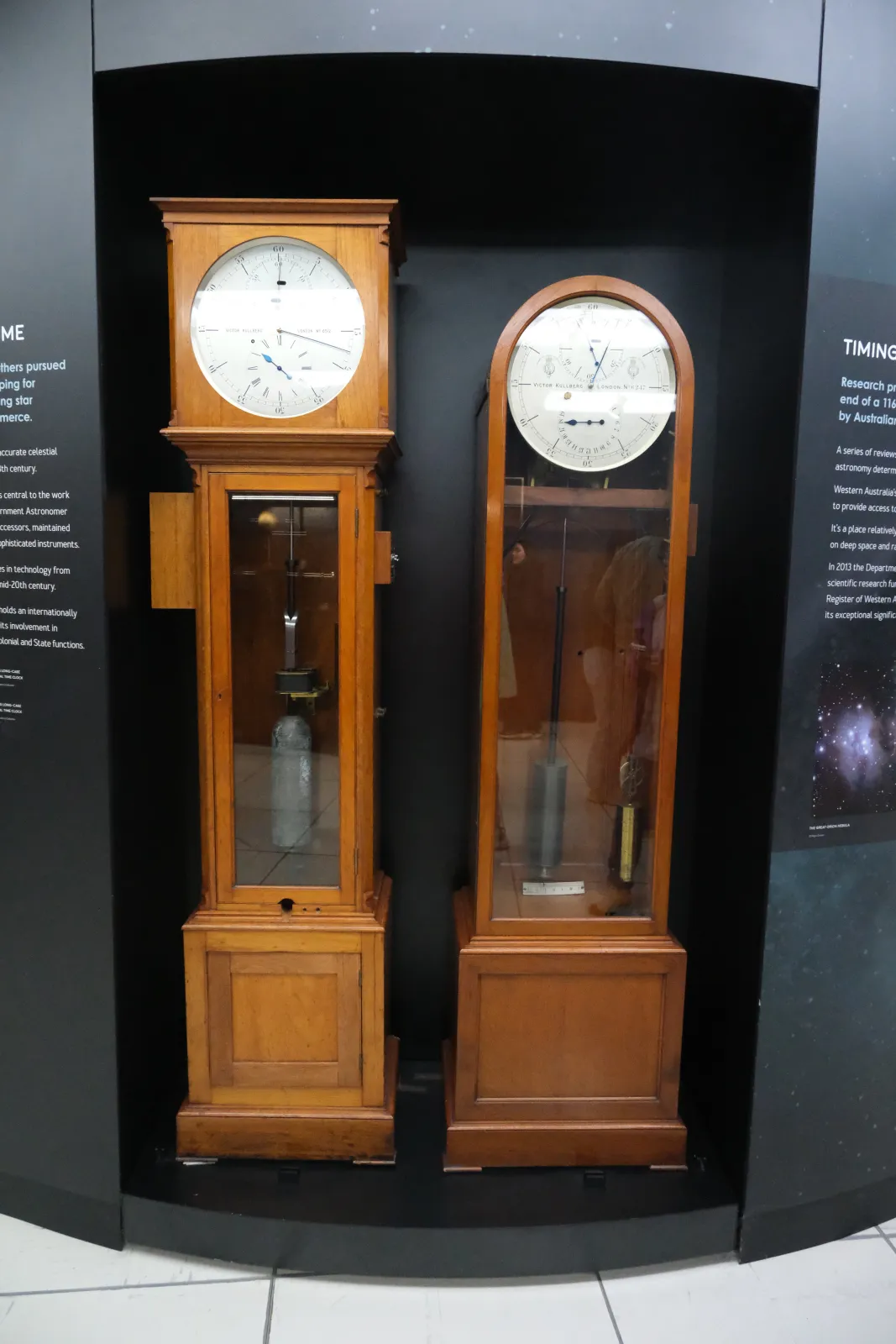
The answer: latitude is easy, longitude needs a clock
The answer is navigation. Back when ships crossed oceans, a ship needed to know where it was, and "where" comes in two parts:
- Latitude. A star is enough. Measure the angle between Polaris and the horizon in the north, or the sun's height at noon anywhere, and that is the latitude.
- Longitude. It needs accurate time. The Earth turns 15 degrees every hour, so with the time back home and the time on board, the difference tells how far east or west the ship has gone.
(Another side note: the nautical mile is tied to this too. One nautical mile is one minute of latitude.1 I remember StarTalk covering this and finding it really cool.)
Do the math and it is clear why a good clock was a matter of life and death. One minute of clock error is a quarter of a degree of longitude, which is about 15 nautical miles at the equator. So every ship needed a clock that stayed accurate for months at sea.
But ship clocks were terrible
A pendulum clock does not like a rolling ship. The solution was John Harrison's marine chronometer, built to be unaffected by the motion of the ship. In a 1764 trial voyage to Barbados, his timekeeper passed the strictest requirements of the day.2
Even so, a chronometer drifts. Before leaving port, a captain wanted to check it against the "true" time. That is what a time ball was for.
It works like this. A big ball sits on a pole near the harbor. A few minutes before the hour it rises to the top. At a fixed hour, often 1 pm, it drops. Ship captains watch it through a telescope and correct their chronometers. The first one was built at Portsmouth in 1829, and Greenwich had its own by 1833.3
Wait, stars at night, but the ball drops in the day?
I got confused here. Stars come out at night, but the ball drops in the middle of the day. How do those fit together?
As I understand it, the answer is the clock in the middle:
- A mechanical clock drifts a little every day, so an observatory builds a very stable one.
- At night, astronomers watch stars cross the meridian, the north-south line overhead. That gives them a very accurate reference.
- They compare it to the clock and work out how much the clock is off. Usually they don't reset it. They write down the error and correct for it.
- In the daytime, the same clock triggers the ball at the set hour.
So: at night we use the stars to calibrate the clock, and in the daytime we use the clock to tell the whole city the time.
Perth's observatory, by the way, was built for exactly this. It opened in 1900 to keep standard time for Western Australia (and to collect weather data). According to Wikipedia, before the first government astronomer arrived, clocks in the colony could differ by up to half an hour. And time was announced each day by a cannon, which is still on the grounds.
And then I looked closer to home
After the trip I started to wonder: was there anything like this in Taiwan?
There was. The Taipei Observatory at 64 Gongyuan Road did the same job. According to the Central Weather Administration:
- 1896: it started measuring the sun's altitude with sextants to set the time
- 1909: a red time ball, one meter across, was installed and dropped at noon
- 1913: an astronomical observation room with a meridian circle and telescopes was completed
- December 1945: after the war, it resumed time calibration
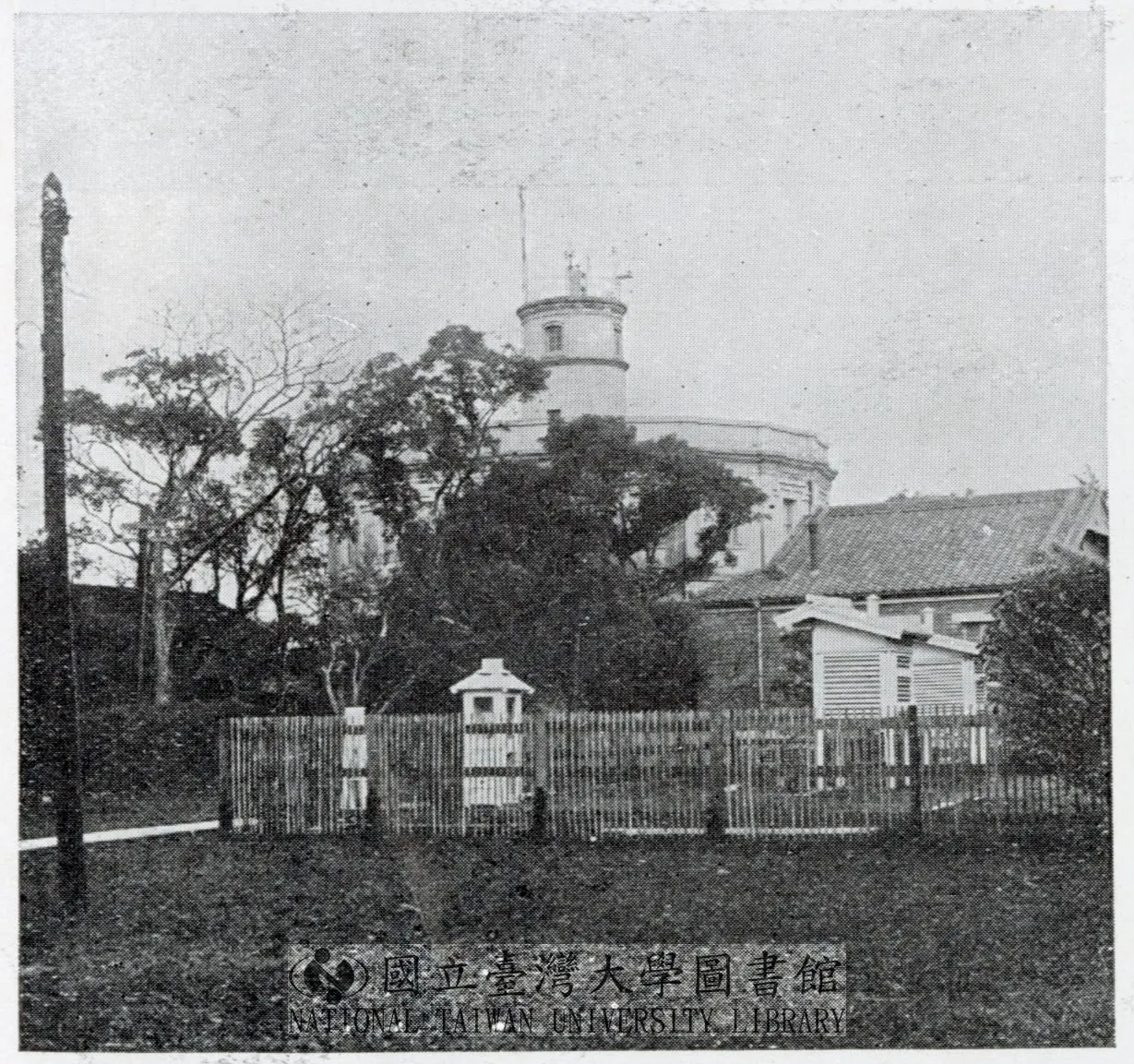
From what I can find, the way Taiwan got its time went from time ball, to noon cannon, to telegraph, to radio. Each step was really the same problem: how do we keep everyone in sync?
Here is the part that is hard to believe. That place is now the Central Weather Administration, formerly the Central Weather Bureau, where my parents worked their whole careers. My dad studied meteorology and my mom was an IT engineer the whole career in exact same place.
I used to go there as a kid.
The sound of an old machine room
Next door on Gongyuan Road is a teachers' college (now the University of Taipei, I think). In the summers I took swimming lessons there. In the afternoons I would go to my mom's office and do my own thing.
What I remember most is the sound. The hum of old cooling fans. A whole room of hard drives reading and writing. Lots and lots of beeps.
Maybe that is why I ended up good at science and computers. Maybe. I can't prove it.
The observatory that almost disappeared
Back in Perth, there was one more thing I learned that night. The observatory lost its government funding. As I understand it:
- 2013: research programs were cut
- March 2015: all but one staff member were made redundant4
- July 2015: volunteers took over running it5
About 80 volunteers went through months of training to reopen the place.4 Today there are around 180, working something like 25,000 hours a year, alongside a small paid staff. Money comes from tours, events, merchandise and donations.5
Our guide was one of those volunteers. And at the telescopes, many of the people teaching us were researchers.
Infrastructure is invisible until it isn't
So here is what I keep thinking about.
The time ball was infrastructure for time. My dad's work was infrastructure for weather. My mom's machine room was infrastructure for the systems around it. And today I work on a compiler, which is infrastructure for running AI.
Good infrastructure is invisible. Nobody looks at the harbor and says "thank you, time ball." Nobody thanks the weather system for a forecast. And when it is invisible, it is easy to cut. Perth's observatory nearly went away. What saved it was people who cared enough to show up.
I told my dad about all this. He didn't react much. Maybe he doesn't care.
But I think I understand that quiet a little better now. It is the sound of a fan in a machine room, doing its job so everything else can.
Footnotes
NOAA, What is the difference between a nautical mile and a knot?. Defines one nautical mile as one minute of latitude, chosen because marine charts already work in latitude and longitude.
Royal Museums Greenwich, Longitude found: the story of Harrison's timekeepers. Harrison's H4 sailed to Barbados in March 1764; the trial confirmed it had kept time "within the most stringent limits of the 1714 Act."
South Street Seaport Museum, Time Balls. Covers Captain Robert Wauchope's 1829 time ball at Portsmouth and the Royal Observatory's own at Greenwich in 1833, which still operates.
ABC News, Perth Observatory reopens with volunteer astronomers (25 September 2015). Reports the 2013 cuts to research programs, the March 2015 redundancies, and the roughly 80 volunteers who trained for months before the reopening.
Perth Observatory, About the Observatory and its Volunteers. Volunteers have run the observatory for the Western Australian Government since 1 July 2015; today it has 7 staff and 180 volunteers contributing over 25,000 hours a year.