Something clicked today during my ML onboarding — a lightbulb moment.
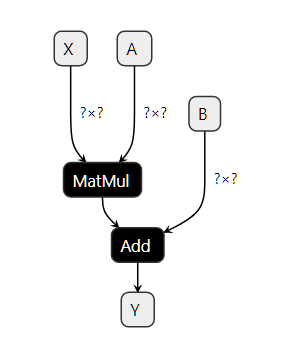
Here is the angle it came from. I was staring at an ONNX operator graph, learning how to use our test framework to check whether our MLIR compiler had correctly optimized that graph, when it suddenly hit me: the essence of machine learning — of deep learning — is that you throw in a huge blob of data, push it through an enormous number of operations, and out comes another huge blob of data, with the result we want hidden somewhere inside it.
That sounds obvious, maybe even absurd to say out loud. But the point is that we do not encode human reasoning up front. We send the data itself through a particular model, and with a suitable loss function and a few other details, we let gradient descent find the classification, the probability, the ranking, object detection — whatever we are after.
The old era of AI was the opposite. Its essence was symbolic: turning the human thought process into symbols. For image recognition, we would hand-define things like color, shape, texture, pattern, edges, shadows, and write them into metadata to tell the computer what counts as a cat. It is no accident that the language of that era was largely Lisp — symbolic AI is symbol manipulation, and Lisp was built to manipulate symbolic expressions.
But in today's deep learning, the data that flows is the program — it is the data, and sometimes it is the control flow too. The input is one big blob of data, called a tensor. The output is another pile of data, another tensor. The only difference between the operators along the way is the dimension, shape, and size of the tensors they pass around.
In some ways, a tensor reminds me of a Lisp object. In Lisp almost everything is an object carrying a type tag — whether it is a number or a list, it can be inspected and manipulated through one uniform interface. In deep learning, almost every unit of data that flows is likewise a tensor carrying metadata: shape, dtype, device. We rarely touch the raw memory buffer directly; we operate on these "self-describing objects" instead.
Going one step further: in Lisp, data and code can take the very same form — the S-expression. In modern deep learning, the path the data (the tensor) flows through is the definition of the whole computation (the computation graph). The two have completely different goals, yet the idea — wrap data into objects rich with information, then let computation happen on those objects — has a strange kind of resemblance.
Here is where Lisp and tensors feel alike:
1. The basic unit, and how shape is represented. In Lisp everything bottoms out in atoms and cons cells, and structure is just nesting. A tensor bottoms out in scalars, and the same nesting is summarized by its shape. Take one concrete 3D block — two stacked 2×3 matrices, i.e. shape = (2, 2, 3) — and write the very same numbers both ways:
Lisp (nested lists):
  (((1 2 3)
    (4 5 6))
   ((7 8 9)
    (10 11 12)))
  ; nesting depth = rank; each level = one axis

Tensor (shape = (2, 2, 3)):
  [[[1, 2, 3],
    [4, 5, 6]],
   [[7, 8, 9],
    [10, 11, 12]]]
  ; (2, 2, 3) = 2 blocks, each a 2x3 matrix
The Lisp list carries the structure implicitly in how deep the parentheses go; the tensor pulls that same structure out into an explicit shape tuple. Same data, two ways of recording "where the nesting is."
2. A uniform interface. You do not need a different accessor per concrete type — one set of operations works across all of them, because the object carries its own description.
Lisp:    (type-of x)  (length x)  (car x)
Tensor:  x.dtype      x.shape     x[0]
3. Data is program. In Lisp an S-expression is both a list you can walk and code you can evaluate. In deep learning the tensors and the operators between them are the graph — the data and its flow are the same artifact the compiler consumes and optimizes.
Lisp:    (+ 1 (* 2 3))
Tensor:  matmul(a, b) + c
; both are values AND the graph to evaluate / lower
4. Dynamism. A Lisp value's type is known at runtime, not nailed down ahead of time; a tensor's shape can likewise be dynamic, resolved only when the data actually arrives. Both defer to "what is actually here right now" rather than a rigid static declaration.
So here is the thought I keep circling back to. Symbolic AI and deep learning look like opposites, but both are attempts to make a machine do work beyond what a human can do by hand — and both reach for the same Lispy move to get there: treat structure as the program. Old AI wrote the symbols by hand; deep learning lets the data's own structure (the computation graph) be the program.
And it does not stop at the model. The compiler stack underneath is built the same way. MLIR is deeply Lispy — its IR is a nested, structured tree of operations and regions, and you generate real C++ from declarative structure: TableGen records describe the ops, and template machinery turns that description into code. It is the same idea Racket leans on — use structure to create code — just wearing C++ and TableGen instead of parentheses. Once you notice the pattern, you see it everywhere: data is program, and program is data.